Suburban properties across Suwanee encounter intense ant pressures driven by dense tree canopies, red clay soil conditions, and high summer humidity. In master-planned developments such as Rivermoore Park, Settles…
Suburban properties across Suwanee encounter intense ant pressures driven by dense tree canopies, red clay soil conditions, and high summer humidity. In master-planned developments such as Rivermoore Park, Settles Bridge, and Olde Atlanta Club, mature oak and loblolly pine canopies allow Argentine ants and odorous house ants to establish massive supercolonies. These workers migrate indoors through plumbing penetrations and window weep holes searching for household carbohydrates and moisture. Carpenter ants frequently nest in moisture-compromised fascia boards, subflooring, and crawlspaces near shaded creek buffers like the Suwanee Creek Greenway. Effective eradication depends on identifying the exact species: spraying generic pyrethroid repellents causes Argentine ant colonies to bud into multiple secondary nests, multiplying indoor activity within 48 hours.
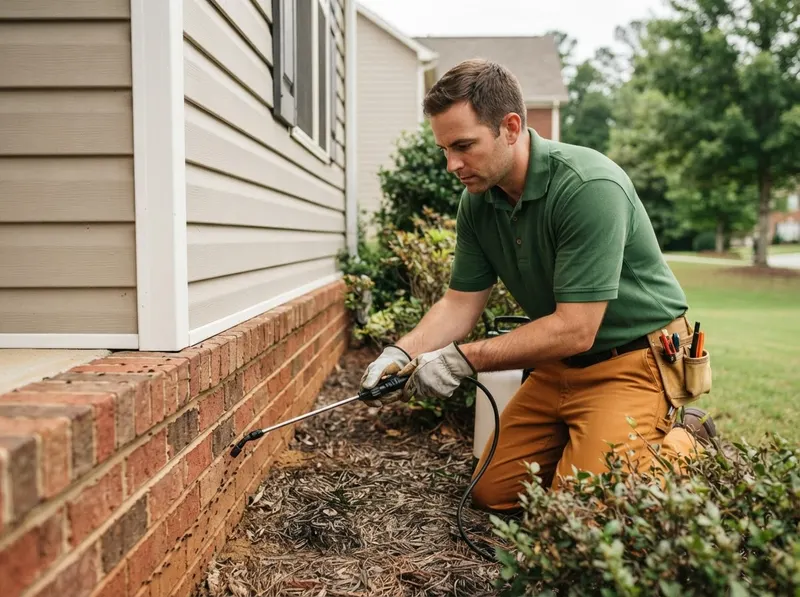
Professional management deploys an integrated pest management (IPM) methodology that protects family living areas while destroying subterranean nesting hubs. Service begins with species-specific identification, distinguishing structural wood excavators from sweet-feeding foraging trails. Technicians apply slow-acting fipronil or indoxacarb micro-baits inside kitchen baseboards and wall voids. Foraging worker ants ingest these compounds and transport them back to the central subterranean queen through social food-sharing (trophallaxis). Exterior foundations across neighborhoods like Laurel Springs, Edinburgh, and The River Club receive a dedicated 3-foot vertical and 3-foot horizontal perimeter treatment using micro-encapsulated non-repellent agents that preserve family living safety.
A single standalone treatment suits minor seasonal forage trails, whereas entrenched multi-queen species require structural exclusion and ongoing perimeter monitoring. Ground mulch beds, ornamental pine straw, and foundation expansion joints in communities such as Suwanee Station, Shadowbrook Crossing, and Lansdowne create direct damp bridges over concrete stem walls. Pulling pine straw 12 inches away from siding, sealing utility entry points with polyurethane foam, and establishing seasonal defense barriers stops reinvasion. The trade-off between fast contact sprays and slow-acting non-repellent colony baits is speed versus complete colony elimination: contact sprays offer immediate visible kill but scatter the queen, while non-repellent colony management requires 5 to 14 days to circulate lethal doses through the entire nest matrix.
Every job gets a firm, written price after a free on-site visit.
Tell us about your ant infestation management job in Suwanee and we'll send a clear, written quote, usually the same day.
 Georgia Pine Pest Control